
CBSE Board Exam 2026: Expected Dates, Revised Exam Pattern, Marking Scheme and Complete Preparation Guide
The Central Board of Secondary Education (CBSE) is expected to conduct the Class 10 and Class 12 board examinations for the 2025–26 academic session in February 2026. Although the official date sheet has not yet been released, academic trends from previous years provide a fairly clear picture of how the examination cycle may unfold.
For lakhs of students across India, CBSE board exams represent a crucial academic milestone. Whether aiming for higher studies, competitive exams, or professional courses, performance in these exams plays a significant role. With that in mind, understanding the expected timeline, exam pattern, and preparation strategy becomes essential.
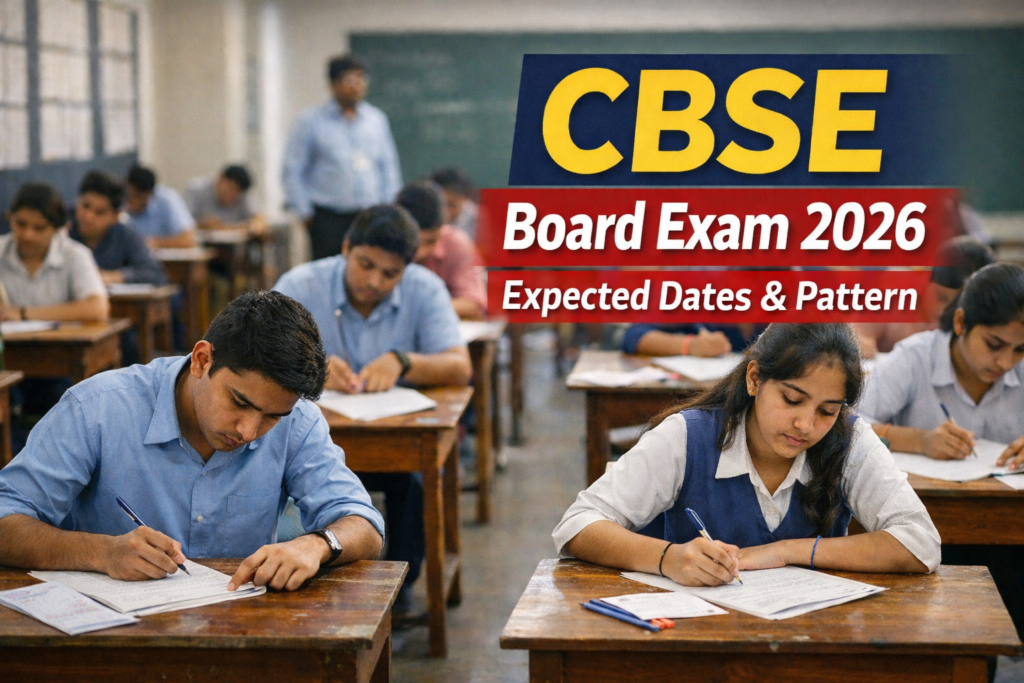
Expected Timeline for CBSE Board Exam 2026
Based on previous examination schedules, CBSE usually releases the official date sheet in December or early January. Practical examinations are typically conducted in January, followed by theory examinations beginning in mid-February.
If the board follows its usual pattern:
- Practical Exams: January 2026
- Theory Exams: Mid-February to March 2026
- Results Announcement: May 2026
Students are advised to regularly check the official CBSE website for verified updates rather than relying on unofficial social media posts.
Revised Exam Pattern: Focus on Competency-Based Questions
Over the past few years, CBSE has gradually shifted from rote-learning evaluation to competency-based assessment. The 2026 board exams are expected to continue this approach.
The question papers may include:
- Case study-based questions
- Source-based analytical questions
- Assertion and reasoning type questions
- Short answer and long descriptive questions
- Internal choice in selected sections
The emphasis is increasingly on conceptual clarity, real-life application, and critical thinking.
For subjects like Science and Mathematics, students may see more application-oriented problems rather than direct textbook questions. In Social Science and English, structured and well-presented answers are likely to fetch better marks
Updated Syllabus and Internal Assessment
CBSE has maintained a balanced syllabus structure after the pandemic-era rationalisation. However, minor revisions are possible each academic year.
Students must:
- Download the latest syllabus from the official CBSE website
- Confirm deleted and added topics
- Avoid preparing outdated chapters from old guidebooks
Internal assessment continues to contribute significantly to final results. Projects, practical work, periodic tests, and attendance may carry weightage depending on the subject.
Marking Scheme and Evaluation Process
CBSE follows a structured evaluation system. Examiners are trained to award step-wise marks, especially in subjects like Mathematics and Science.
Important evaluation features include:
- Marks awarded for correct steps even if the final answer is slightly incorrect
- Clear marking scheme for descriptive answers
- Importance of diagrams, headings, and structured presentation
- Penalty for exceeding word limits in language papers
Students should practice writing answers within the specified word limit while maintaining clarity.
How Students Should Prepare for CBSE 2026
With several months available before the examination, students have enough time to build a strong preparation strategy. Instead of last-minute cramming, a structured and disciplined routine can make a significant difference.
- Complete NCERT Thoroughly
NCERT textbooks remain the foundation for CBSE exams. Most questions are either directly or indirectly based on NCERT concepts.
2. Solve Previous Year Question Papers
Analyzing past papers helps students understand:
- Repeated question patterns
- Frequently asked topics
- Marking distribution
Practicing under timed conditions also improves speed and confidence.
3. Attempt Sample Papers
CBSE releases official sample papers every year. These papers provide clarity on the latest exam pattern and marking scheme.
4. Focus on Weak Subjects Early
ignoring weak areas until the final months often creates pressure. Early revision and doubt-clearing sessions can prevent unnecessary stress.
- Maintain Consistency
Studying consistently for 3–4 focused hours daily is more effective than studying 10 hours irregularly.
Managing Stress During Board Exam
board exams often create anxiety among students and parents alike. However, excessive pressure can negatively impact performance.
Students should:
- Maintain a regular sleep schedule
- Take short breaks between study sessions
- Avoid comparing preparation levels with others
- Stay physically active
Parents and teachers should encourage rather than pressure students during this period.
Frequently Asked Questions (FAQs)
When will CBSE release the official date sheet for 2026?
The date sheet is expected to be released between December 2025 and January 2026, based on previous trends.
Will the exam pattern change again in 2026?
Major structural changes are unlikely. However, competency-based questions will likely continue to increase.
Are NCERT books enough for preparation?
For most subjects, thorough preparation of NCERT books is sufficient. Additional reference books may help in concept clarity but are not mandatory.
When are CBSE 2026 results expected?
Results are generally declared in May, though the exact date depends on evaluation timelines.